
Key Takeaways:
- You don’t need to quit work or sacrifice sleep to earn a qualification.
- Most people drop out because they set up the wrong study load, not because study is too hard.
- Plan around your work commitments to ensure you manage time well.
- Burnout has specific warning signs. Knowing them early means using a strategy like deferring a unit to protect your studies.
Wondering how to balance study while working full time? You are not alone. According to the Australian Bureau of Statistics, over 380,000 Australians work full-time and study part-time. This shows plenty of Australian adults want a qualification but aren’t willing, or able, to walk away from a stable income. The good news is they don’t have to.
Workers who successfully complete courses while working full time don’t find hidden reserves of time. Rather, they plan smarter from the start.
Having worked with adult learners for over 15 years and recommending these 10 study tips for working professionals, we’ve seen firsthand what can make it successful. By following a few practical tips, you can make balancing study with full-time employment far more manageable.
Tip 1: Decide your study load before you enrol
Balancing study with full-time employment can be a challenge. Our advice is don’t enrol until you’ve reviewed how many hours you can realistically dedicate to study.
Many students sign up first and plan to figure out their schedules later. The problem is, they don’t know how many units they can realistically handle in a week. Without reviewing how many hours each unit requires, you may start off strong because you’re strongly motivated in week 1, but by week 4, you realise you have competing work and study assessment deadlines competing for your attention. Part-time study while working full-time can provide a good win-win solution.
This leads to stress and ultimately, poor study performance. Finishing a qualification slowly is always better than overcommitting and dropping out halfway through due to stress.
TIP: Having worked with full-time employees, the CAL Student Support Coaches find that if you’re working 38 to 40 hours a week, starting with one unit is more sustainable than taking on 2-3 units. Self-paced courses like those at CAL are designed to give you flexibility. But flexibility only works if you use it deliberately.
Tip 2: Plan according to your work calendar

Busy periods at work don’t disappear because you’re studying. The end of the financial year, reporting periods, project launches or seasonal peaks can all collide with assignments.
Before enrolling, map out the next three months and identify:
- Major projects and busy periods
- Annual leave
- Family commitments
Build your study schedule around work. And if something unexpected happens, contact your trainer as soon as possible. Most course providers are willing to offer extensions or alternative arrangements if informed in advance.
Tip 3: Know your funding options
The cost of studying and the risk of going into debt are very real sources of stress for working adults. Take advantage of these options to make part-time study while working full-time more affordable.
Employer budgets
Many contracts include professional development allowances. Ask HR directly before paying out of pocket, as your employer may pay for some or all of your course fees. If your employer does not offer professional development allowances, you should still have those conversations if you plan on studying to get ahead in your current job.
Flexible payment options
Many training providers, including the College for Adult Learning (CAL), offer competitive, flexible payment options to suit your budget and lifestyle. For more information on our fees and payment plans, visit our ‘Frequently Asked Questions‘ page and look at the ‘flexible payment options’ section.
Tax deduction
If the course maintains or improves skills and knowledge related to your current job, or will likely result in an increase of salary, you may be able to claim some of your course fees and materials as a self-education tax deduction on your tax return. See ATO’s rules around self-education expenses.
Tip 4: Tell your employer before you enrol
Many people avoid telling their employer they’re studying because they’re worried it will affect their full-time position. The good news is that it doesn’t have to be that way. Often, it’s how the conversation is framed that matters. Most employers respond well when the question is framed around skills development and growth, which can ultimately help the business. Not around asking for time off.
Try something like this to position your course as professional development that benefits both you and the business:
“I’m completing a qualification that will help me improve [specific outcome relevant to your role]. I’d love to discuss whether there’s flexibility to leave one hour earlier on [specific days, like Tuesdays and Wednesdays, to study]. I’m happy to make up the time.”
Tip 5: Prioritise tasks with the Eisenhower Matrix
Knowing what to prioritise when you have conflicting interests can be a challenge. Work is your income, whereas study is your future. When work and study demand the same time, sometimes you can fall into the trap of decision paralysis, that is, “prioritising rather than actually working”. These time management hacks for study can help you stay organised and reduce stress. Another smart solution is to use some proven time management techniques, like the Eisenhower Matrix. This is a way to simplify what deserves your attention:
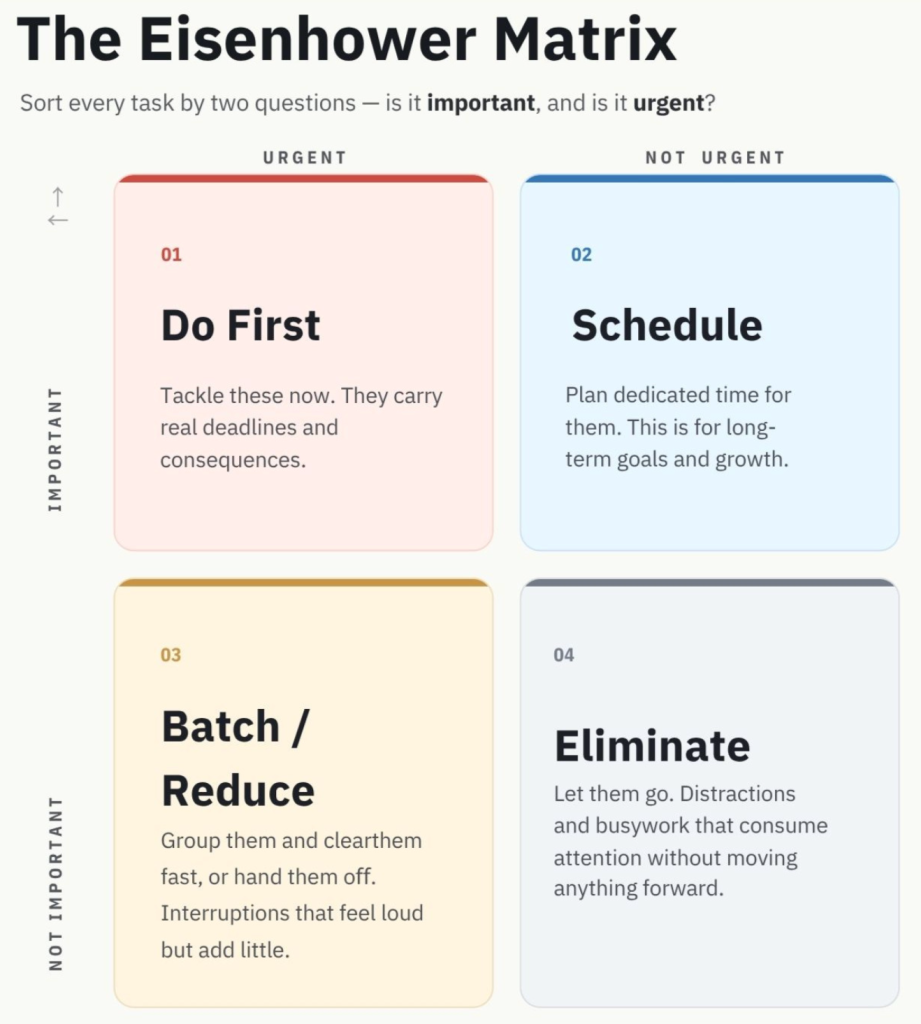
Here is an example of the Eisenhower Matrix that one CAL student made for themselves while working a full-time job.
| Do now |
Schedule |
- Assignment due tomorrow
- Genuine work emergency
|
- Weekly readings
- Assessment preparation or revision
- Essential emails
|
| Batch or reduce |
Eliminate |
- Low-priority admin
- Non-essential emails
|
- Doomscrolling on TikTok
- Binge-watching Netflix
|
Tip 6: Study in micro-sessions, not marathons
One thing you don’t have when working full time is free time! But the good news is, a study schedule doesn’t have to equal huge blocks of study time. If you break it up to 20-25 focused minutes, it can be more effective at keeping momentum than forcing yourself through a three-hour session after work.
Here are examples of what CAL learners actually do to make the most of their limited time:
- Downloading materials offline so they can study while taking the train to work or during lunch.
- Listening to recorded lectures while driving or exercising.
- Stacking study time onto a daily habit, like reviewing flashcards before brushing their teeth.
Tip 7: Know the warning signs of burnout and how to deal with it
Finding the right work and study balance is key. Avoiding burnout while studying and working isn’t about pushing harder. It’s about recognising when your body and mind need adjustments.
According to Beyond Blue, these are the common warning signs of burnout:
- Fatigue that sleep doesn’t fix
- A feeling of building stress that doesn’t go away
- Disengagement from work or studies that you used to enjoy
- Repeated illnesses like headaches and body pain
- Difficulty concentrating
- Increased irritability or exhaustion
If two or more of these signs persist for two weeks, take a break! A sustainable strategy to protect yourself from burnout includes reducing your workload, asking for some dedicated time off, speaking to your course provider about extending deadlines, or deferring a unit.
Here’s what a Student Success Coach at CAL had to say about deferring:
“It’s hard for a lot of people to accept that they need to defer. They feel ashamed or embarrassed about needing extra time and think of it as a failure. Deferring isn’t giving up; it’s protecting your ability to finish. The goal is to still be enrolled in six months so that you can complete the course, rather than drop out from pressure.”
If you’re experiencing burnout from your work-life-study balance, support is available from organisations such as Beyond Blue (1300 22 4636) and Lifeline (13 11 14).
Tip 8: Use tools built for time management
The right tools can simplify time management for working students struggling to know how to manage work and study. Here’s what the CAL team recommends to our students:
| Task |
Tool |
| Schedule study blocks |
Google Calendar: colour-code study sessions and treat them like appointments you wouldn’t cancel |
| Stay focused |
|
| Track assessments and competing workload |
- Notion (all-in-one workplace for task management and note-taking)
- Microsoft OneNote (freeform tool that acts like a digital notebook)
- Todoist (create tasks and allocate them to projects)
|
| Revision/retention |
|
Tip 9: Build one buffer week per month into your plan
Life happens. Projects run late. Kids get sick. Work gets busy. Be realistic with your planning; allow one “catch-up week” into each month. Build this into your calendar plan and deadlines. This means you don’t assign any work during this time. This acts as a buffer for catching up on any missed tasks.
It prevents burnout, protects against perfectionist scheduling, and keeps you on track without the stress of “what if I get sick”. Be realistic with your time; you want to be successful in your studies and get the most out of your experience. Adding in a buffer week will ensure you can stay focused and on track.
Tip 10: Reward yourself along the way
Studying while working full time is months of effort that can feel invisible. Especially with online study: there’s no campus, no peers, and no external signal that you’re moving forward. Without self-rewards or rewards from your family, motivation can easily fade.
Break your journey into smaller wins, celebrating each unit completed, every assessment submitted and every unit finished. Track them somewhere you can see them, such as on sticky notes, in a spreadsheet, or on a wall calendar. Share them with your family and friends! Progress needs to be visible. The habit of noticing your progress is what helps people stick with it until the end, when the initial enthusiasm has faded.
Remember, you are human. Take holidays and breaks, allow yourself to unwind and be proud of your achievements. The planning and resources required to balance study and work are challenging!
You don’t need to be superhuman to work and study at the same time
People who successfully manage work and study aren’t necessarily more disciplined or more motivated than everyone else. They plan better. Balancing study with full-time employment becomes much easier when you choose a realistic workload, build flexibility into your schedule and give yourself permission to adjust when life gets busy.
Looking to study while working?
CAL offers flexible, self-paced, nationally recognised courses built for adults who are already working. Browse the full range of online courses, or speak with an advisor about which qualification is a good fit for your goals.
EXPLORE COURSES